

Picture the call. A small accounting office in Fort Myers gets hit with ransomware on a Thursday. The owner is weirdly calm about it, because the backups are good. Tested, stored offsite, the whole deal. Restore over the weekend, open Monday, no big deal. Then on Saturday the attackers email him a sample of what they took. Client names, Social Security numbers, last year returns. Five days to pay or it all goes on a leak site.
What gets you back: Backups answer the encryption half of double extortion and do nothing at all about the leak half, which is worth knowing before you budget for either. A copy of your Microsoft 365 data that lives outside Microsoft is still the difference between a bad week and a wire transfer (here is how we set that up).
Double extortion ransomware Fort Myers businesses are running into now works in two stages, and backups only solve one of them. The crew gets in copies everything worth copying, and only then triggers the encryption. By the time you see the lock screen, your data has already left the building.
How the two stage attack works
Old school ransomware was a smash and grab. Break in, encrypt, demand money, move on. If you had clean backups you told them to pound sand and restored on your own schedule. That worked well enough that it stopped being profitable for the attackers.
So they adapted. Encryption is now the last step instead of the first. Before anything gets locked they sit on your network for days, sometimes weeks. Mapping shares. Finding the folder where you keep scanned IDs and payroll. Copying it out slowly enough that nobody notices the bandwidth.
Then comes the lock screen, and behind it the second demand, which is the one that actually has leverage. Pay us, or your client list and your employee W2s go public.
Ransomware volume rose roughly 20 percent year over year through the first half of 2026, and US small and mid sized businesses are still absorbing the biggest share of it. Average ransom demands aimed at companies your size now run past $120,000. That’s before you count downtime, legal fees and the notification letters you have to mail out.
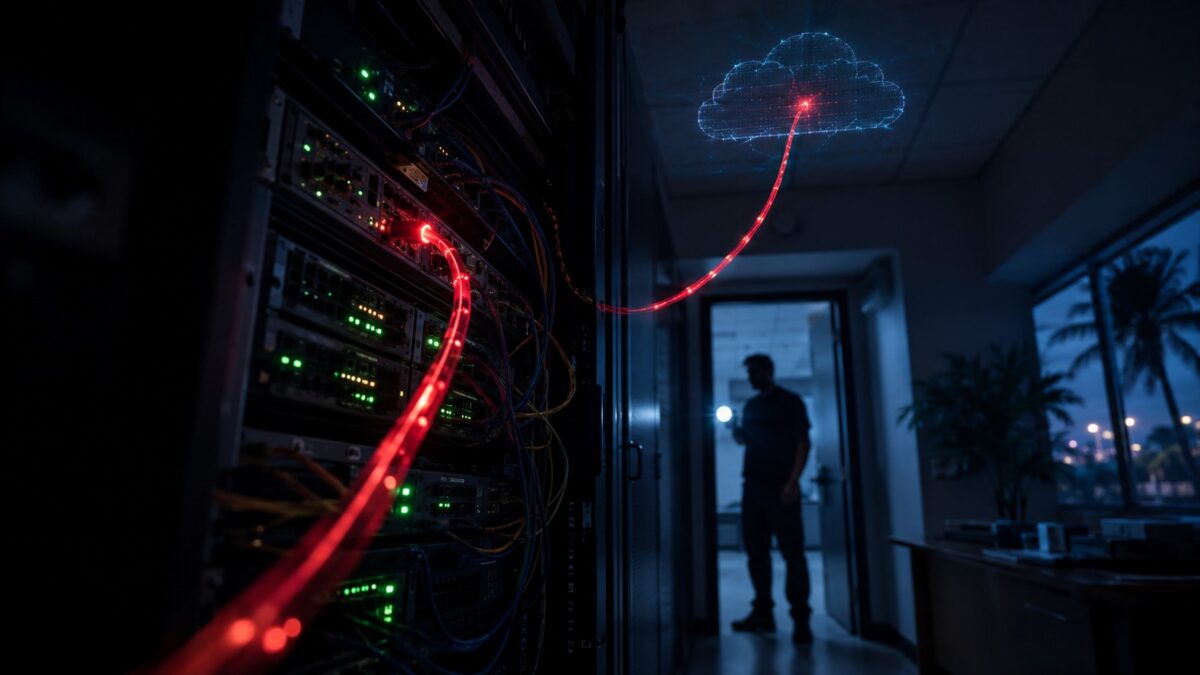
What it looks like before the lock screen
The encryption is the loud part. Everything before it is quiet, which is exactly why small offices miss it.
Things worth paying attention to: an admin account nobody remembers creating, a workstation running hot overnight, backup jobs that suddenly start failing for no reason, antivirus that got switched off on one machine and nobody said anything. Any one of those could be nothing. Two in the same week is worth a phone call.
Sometimes the tell is dumb and small. The internet feels sluggish on a Tuesday afternoon because a couple hundred gigs are going out the door. Catch it at that stage and you never reach the ransom note at all, which is about the best outcome available once someone is already inside.
Why small offices in Southwest Florida get caught
Nobody is targeting Cape Coral. That’s the part people get wrong. These crews scan the entire internet looking for an exposed remote access port or a server missing three months of patches, and whoever answers gets hit. A nine person insurance agency in Bonita Springs and a nine hundred person company in Atlanta look identical from the outside.
Small offices just tend to lose worse. There’s usually nobody watching the network after 6pm. File shares are wide open because it was easier that way five years ago and nobody revisited it. The same admin password has been floating around since 2019. And a small firm often holds more sensitive data per employee than a big one does, a medical billing office in Naples might sit on thousands of patient records with four people on staff.
Double extortion ransomware in Fort Myers: what actually helps
Keep the backups. They still matter and they still get you back online. Just stop treating them as the entire plan.
What breaks the first half of the attack is making your data harder to reach and the theft harder to hide. A few things worth doing this month:
- Get remote desktop off the open internet. If people need remote access, put it behind a VPN or a real remote support tool. This single change closes the door on a large chunk of these attacks.
- Lock down file shares by department. Not everyone needs the payroll folder. If a compromised front desk login can reach every file in the company, you have handed over the whole vault.
- Put something in place that watches outbound data. Most small offices have no idea what leaves their network. An endpoint tool that flags a workstation uploading 40 GB at 2am costs less per month than one hour with a breach attorney.
- MFA on everything, including the accounts nobody thinks about. Stolen credentials are still how most of these start.
- Write down who you call, before you need the list. Your IT people, plus your cyber insurance carrier, your attorney, and whoever handles breach notification. The first few hours matter and nobody thinks clearly at 11pm.
CISA publishes a free StopRansomware guide that goes deeper than any blog post can, and it’s worth an hour of somebody’s time at your office. If you want the step by step version of what happens after an incident, we wrote that up separately in our first 24 hours breach response plan.
Paying does not actually end it
Im going to take a position here that some people will argue with. Paying the second demand buys you a promise from criminals and nothing else. There is no delete key you can verify. Businesses have paid and then watched their files show up on a leak site anyway, sometimes months later when the crew got arrested and their servers were seized by police.
That said, Im not the one whose client list is sitting on somebody’s server in eastern Europe, and if your insurance carrier is running the negotiation you should listen to them. Just go in clear eyed about what you are buying.
Get a second set of eyes before it happens
HenkTek handles IT and cybersecurity for small businesses across Fort Myers, Cape Coral, Bonita Springs and Naples. The calls we like are the boring ones. Somebody wants a second look at their backups, their remote access setup, and who on staff can reach what. That conversation takes an hour. The other call, the one at 11pm on a Friday with a lock screen on the server, takes three weeks and a lawyer.
If you are not sure what your exposure looks like right now, get in touch and we will walk through it with you. Free consultation, no pressure. Or just call (239) 234-2334.
HenkTek is a local IT company in Fort Myers that looks after the technology Southwest Florida businesses depend on, from Cape Coral and Bonita Springs to Naples. We handle managed IT, cybersecurity, backups and help desk support, and we explain things in plain English.