

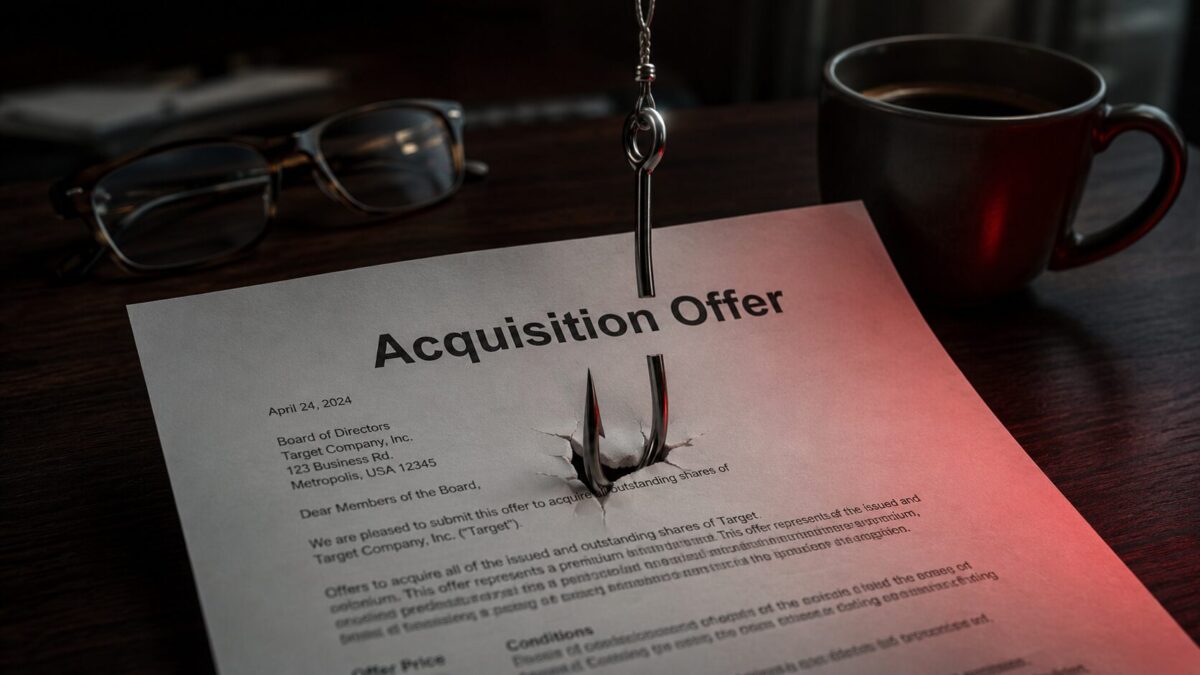
An email showed up in a Cape Coral business owner’s inbox last week. “We have a private equity group looking to acquire businesses in your space. Would you be available for a brief call?” No firm name, no deal terms, just flattery and a calendar link.
It feels good to be wanted, and that’s exactly what the people behind this are betting on. Consumer watchdogs flagged a wave of these fake acquisition emails on July 20, and the same buyout scam is hitting Fort Myers inboxes right now. Here’s how it works, what the senders are after, and how to tell a real inquiry from a trap.
What the email looks like
Generic. That’s the biggest tell. The message could have gone to ten thousand companies, because it did. The two most common templates read almost word for word like this:
“One of our clients is actively seeking acquisitions in your industry and thought your business would be a good fit.”
“We represent a family office looking to acquire businesses in your space.”
Some cold M&A email is real. Private equity firms, search funds, and brokers do send unsolicited outreach, and companies worth $1 million to $100 million get plenty of it. But those buyers are not chasing a five person lawn crew in Bonita Springs. When ConsumerAffairs dug into the scam versions, researchers found sender names that don’t exist, firms with no website, and emails sent to companies that had already dissolved. Nobody running a real acquisition emails a dissolved company.
AI writing tools made this kind of outreach nearly free to produce, which is why the volume jumped this summer. A scammer can send fifty thousand polished, personal sounding emails before lunch.
What they’re actually after
There isn’t one single endgame, which is what makes this scam slippery. Investigators have tracked at least six.
The mild version is lead generation. You reply, and your contact info gets sold to brokers. Annoying, not fatal. The paid valuation scam stings more: once you show interest, the “buyer” requires an independent valuation report, and the sender happens to know a company that sells one for a few thousand dollars. Then there’s plain advance fee fraud, where legal fees or escrow deposits have to be paid before the deal can move forward.
The versions we worry about at HenkTek are the technical ones. Follow up emails carry fake LOIs, NDAs, or financial questionnaires that install malware or steal your Microsoft 365 login. Some senders collect your revenue numbers, customer lists, and supplier details, which have value all on their own. And the worst case: the whole conversation is a setup for business email compromise. The scammer learns how your company moves money and who approves payments, then uses that knowledge to impersonate you or a vendor months later.
Why this lands so well in Southwest Florida
A huge share of local companies are owned by people in their 50s and 60s who are already thinking about an exit. Ask around at any chamber event and you’ll hear it. Someone is always a year or two from selling. So an email about a buyer showing up out of nowhere doesn’t read as absurd here, it reads as good timing.
Scammers know the demographics too. Service businesses, medical practices, marine companies, and contractors around Lee and Collier County are exactly the kind of targets that make a vague acquisition pitch feel plausible. The pitch works because part of you wants it to be true. No shame in that. Just know it about yourself before you hit reply.
How to spot a buyout scam in Fort Myers
Run any acquisition email through this filter before you reply. Most buyout scam emails fail the first two checks.
- Is a real firm named? Vague lines like “a private equity firm in our network” are a red flag on their own.
- Check the sender’s domain. Free email accounts and domains registered last month end the conversation.
- Look the people up on LinkedIn. Real M&A professionals have long public histories.
- Did they ask for money? Legit buyers never charge the seller a fee. Not for valuations, not for escrow, not for anything.
- Are they demanding financials before telling you who the buyer is? That’s backwards. Real outreach identifies the buyer after an NDA, then asks reasonable questions.
One more test that works surprisingly well: reply and ask which specific firm they represent and what they know about your business. Scammers either vanish or dodge the question. A real buyer can tell you exactly why they picked you.
If you already replied
Replying alone mostly confirms your email address is live, expect more spam but not much else. If you went further, act on what you shared. Sent financials? Alert your bank and put a verbal confirmation rule on outgoing payments. Opened an attachment or typed your password somewhere? Get the machine checked and change that password now, starting with email. And report the email to the FTC at reportfraud.ftc.gov so the pattern gets tracked.
Get a second set of eyes before you reply
We check suspicious emails for Fort Myers area businesses all the time. Header analysis, domain age, sender history, the works. It takes us minutes and it has saved clients from expensive mistakes. HenkTek handles email security, phishing protection, and managed IT for small businesses across Fort Myers, Cape Coral, and Naples. If a buyout offer, or any email, feels off, forward it to us before you answer it. Call (239) 234-2334 or reach out through our contact page for a free consultation.

HenkTek is a local IT company in Fort Myers that looks after the technology Southwest Florida businesses depend on, from Cape Coral and Bonita Springs to Naples. We handle managed IT, cybersecurity, backups and help desk support, and we explain things in plain English.