

Last week we covered what happens to the hard drives when old computers leave your office. This is the other half of that problem: the paper. Client files, payroll runs, intake forms, that box of 2019 invoices in the storage closet. If it has a name or an account number on it, it can’t go in the dumpster behind your Fort Myers office the way it is.
Heads up: some links in this post are affiliate links, which means HenkTek may earn a commission if you buy through one. It costs you nothing extra and it does not change what we recommend.
Shredders are rated by how small they cut, and the P-4 vs P-5 split covers nearly every office machine worth buying. Pick wrong in one direction and you paid extra to grind paper into dust nobody asked for. Pick wrong in the other and you’re out of compliance every time the bin gets emptied.
Here’s what the two levels mean, and four machines worth a look, two at each level.
What P-4 vs P-5 shredders actually cut
The ratings come from DIN 66399, the German standard the whole industry runs on. The number tracks particle size. A P-4 machine cuts paper into cross cut pieces no bigger than 160 square millimeters, roughly a bit of confetti. A P-5 machine has to get under 30 square millimeters with no strip wider than 2 millimeters. Think a grain of rice, split lengthwise.
A P-4 particle can still carry a few readable characters. A P-5 particle mostly carries ink.
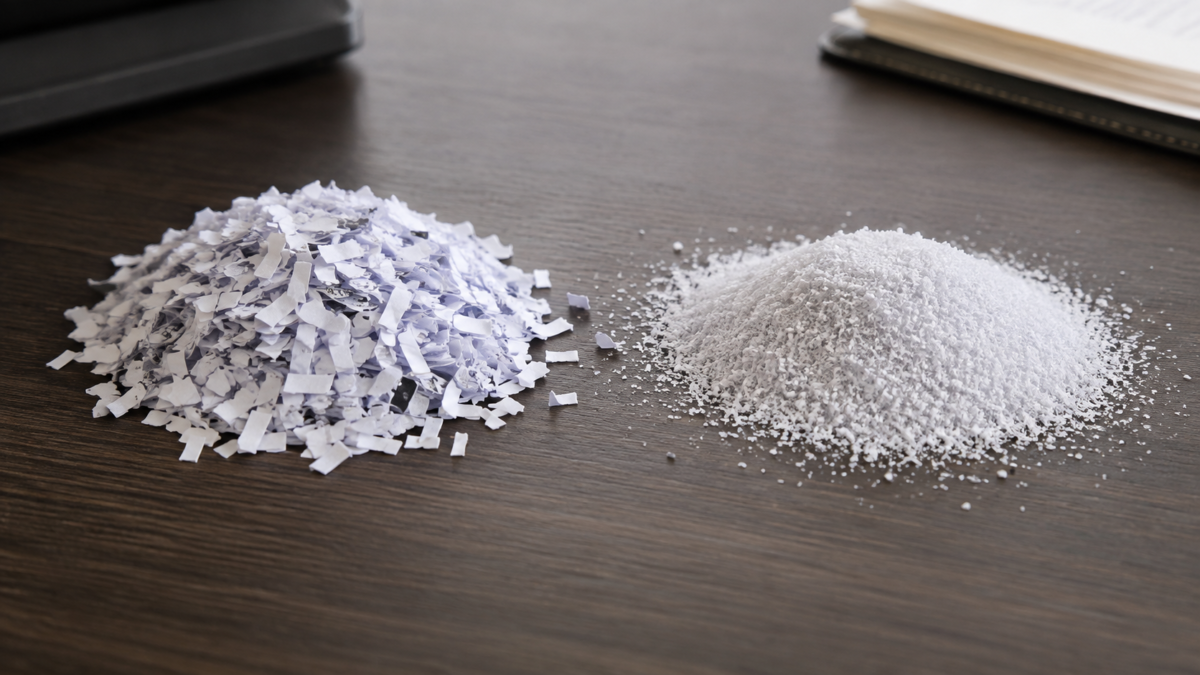
One thing to skip entirely: strip cut machines, the P-2 stuff still stacked in big box stores. Long ribbons can be pieced back together by hand. It famously happened to the shredded embassy files in Tehran after 1979, and software has only made reassembly easier since. Cross cut is the floor. No exceptions.
Which level your Fort Myers office needs
For most businesses, P-4 is the honest answer. The FTC’s Disposal Rule requires reasonable measures when tossing anything derived from a consumer report, and it names burning, pulverizing and shredding. A P-4 cross cut clears that bar for routine business paper. Retail shops, contractors, property managers, most professional offices land here.
P-5 is for offices where the paper itself is the sensitive asset. Medical and dental practices shredding anything with patient info. Law firms. Accounting and tax offices, where a single page can hold a name, an SSN and a bank account number. HIPAA never prints a particle size, it just says disposed records must be unreadable and beyond reconstruction. Florida’s FIPA law expects reasonable disposal measures from anyone holding customer records. What you’re buying at P-5 is the end of that conversation. Nobody reconstructs a P-5 bin.
Fair warning on the tradeoff: the finer the cut, the fewer sheets per pass and the more often the head needs a cooldown. That’s normal, not a defect. Smaller blades, more work per sheet.
The four worth buying
| Model | Level | Sheets per pass | Best feature | Price (8/24) |
|---|---|---|---|---|
| Fellowes AutoMax 100M | P-4 | 100 auto / 10 manual | Load it and walk away | $269 |
| Bonsaii C266-B | P-4 | 12 | Under $100, bin on casters | $93.49 |
| Wolverine SD9101 | P-5 | 8 | 54dB, actually quiet | $169.97 |
| Aurora AU830MA | P-5 | 8 | 20 min continuous runtime | $142.48 |
We didn’t run reams through these four ourselves. The picks come from the spec sheets, the security ratings printed on each listing, and the failure patterns in a few hundred owner reviews, which cluster around overstuffed auto feeds, not cut quality. Prices were checked August 24 and they move, so treat every number as a snapshot. The Wolverine has bounced twenty bucks both ways this month.
The P-4 picks
Fellowes AutoMax 100M, $269. The office workhorse. Stack up to 100 sheets in the tray, close the lid, go back to work. It pulls the pile through on its own and stops when it’s done. A manual slot takes 10 sheets for quick jobs, and it chews through staples, paper clips and old credit cards without complaint. Cut size is 5/32 by 25/64 inches, comfortably inside P-4. The 6 gallon pull out bin means you aren’t emptying it twice a week, and auto reverse catches jams before they set. If your office produces a banker’s box of paper a month, this is the one.
Bonsaii C266-B, $93.49. The budget P-4. Twelve sheets per pass, micro cut, and the 4.2 gallon bin rolls on casters so it can live under a desk. Takes cards and staples fine. There’s no auto feed, so someone stands there feeding it, which is no problem for an office that shreds a folder now and then instead of a crate.
The P-5 picks
Wolverine SD9101, $169.97. A P-5 machine that runs at 54 decibels, about the level of a quiet conversation, so it can run while someone two desks over is on the phone. Particles come out at 2 by 12 millimeters. Eight sheets per pass, a 4.5 gallon bin, steel gears underneath. In a shared Cape Coral front office the quiet is worth real money, because the loud shredder is the machine nobody uses.
Aurora AU830MA, $142.48. The cheapest clean way into P-5. Eight sheet micro cut, rated for 20 minutes of continuous running before it needs a rest, takes credit cards too. Nothing fancy anywhere on it, which is the point. A solo practice or a two person office that wants medical grade particles without medical grade spending ends up here.
Shredding is half the job
Paper is only one place your client data lives. The same disposal thinking covers the hard drives in the computers you retire, and that’s the half most offices miss. We wrote up safe computer disposal last week, and the two posts pair together as a checklist.
If you’d rather hand the whole data handling question to somebody local, that’s what we do. HenkTek handles IT and security for small businesses across Fort Myers, Cape Coral and Naples, including the unglamorous parts like disposal policies that keep you off a breach notification list. Reach out for a free consultation or call (239) 234-2334.

HenkTek is a local IT company in Fort Myers that looks after the technology Southwest Florida businesses depend on, from Cape Coral and Bonita Springs to Naples. We handle managed IT, cybersecurity, backups and help desk support, and we explain things in plain English.